We’re excited to announce several new and updated library guides and tutorials designed to make your academic journey smoother and more successful! We have a few guides and tutorials focused on data management, a brand new guide on case studies, while also fully updating our Writing & Publication Hub. Read more below!
New Guide
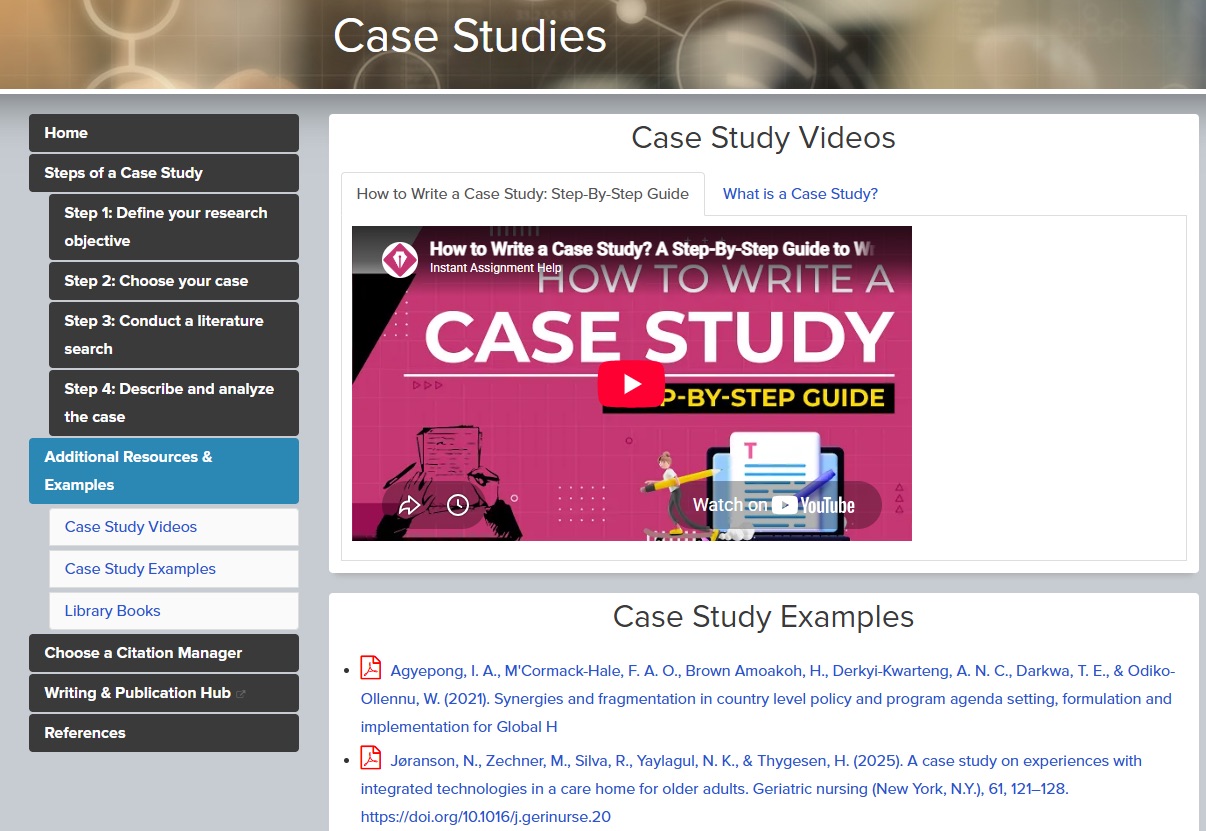
Case Studies This library guide gives a clear, practical rundown of how case study research works, breaking it down into three main areas:
What a Case Study Actually Is: Covers the basics of what case studies do—specifically, how they zoom in on real-life subjects (like a person, business, or event) using tools like interviews and documents to tackle “how” and “why” questions.
What It’s Not (and Key Differences): Clears up common misconceptions by explaining what case studies don’t do—like proving cause-and-effect or serving as broad surveys. It also spells out the difference between a clinical case report (which focuses on a single patient’s medical care) and a case study (which looks at bigger systems, policies, and real-world issues).
The Step-by-Step Process: Walks through the four main stages of carrying one out: setting your research goal, picking your subject, reviewing the existing literature, and digging into the data to draw insights.
Updated Guides
Case Reports This library guide offers a practical breakdown of case reports in medical research, organizing the material into three main areas:
Scope and Limitations: Explains that a case report is a quick, observational account tracking a single patient (or two) to share novel diagnoses or unique treatment outcomes—while clarifying that it isn’t a formal experiment, broad statistical study, or proof of a general cure.
Case Report vs. Case Series: Highlights the distinction between a single-patient profile and a case series (which tracks a group of patients on similar treatments), noting that including more than three patients crosses into formal research requiring IRB approval.
Creation & Publishing Guidance: Walks through the essential steps to write a case report (from getting patient consent to following CARE guidelines) and points out submission perks from the library for journals like BMJ Case Reports.
This updated guide is meant to be a starting point where you can access a multitude of our other guides focused on publication, writing, citation, and more.
Hub Purpose & Support Network: Serves as a central launchpad for academic writing and publishing, connecting users directly with liaison librarians, scholarly support services, and university partners like the Writing Center and Research Hub.
Core Writing & Integrity Resources: Provides quick access to foundational research and writing tools, including dedicated guides on scientific writing, proper citation formats, plagiarism, and copyright.
Publishing & Open Access Guidance: Navigates the publishing landscape by offering practical advice on manuscript submission, understanding open-access options, and expanding the reach of scholarly work.
Mastering the SciENcv Biosketch This tutorial guides researchers through managing their digital research identity and using the SciENcv platform to create agency-compliant biosketches with confidence. The tutorial demonstrates how to automate publication imports, generate certified biosketch documents, and simplify the preparation process for grant applications.
Mastering Research Data Management (RDM) and the NIH Data Management and Sharing Policy This tutorial provides a behind-the-scenes look at developing an effective Data Management and Sharing (DMS) Plan. Researchers will gain a clear understanding of each required plan element, learn how to apply them to NIH-funded projects, receive a hands-on demonstration of the DMPTool, and explore how the 2023 NIH DMS Plan aligns with the updated 2026 requirements.