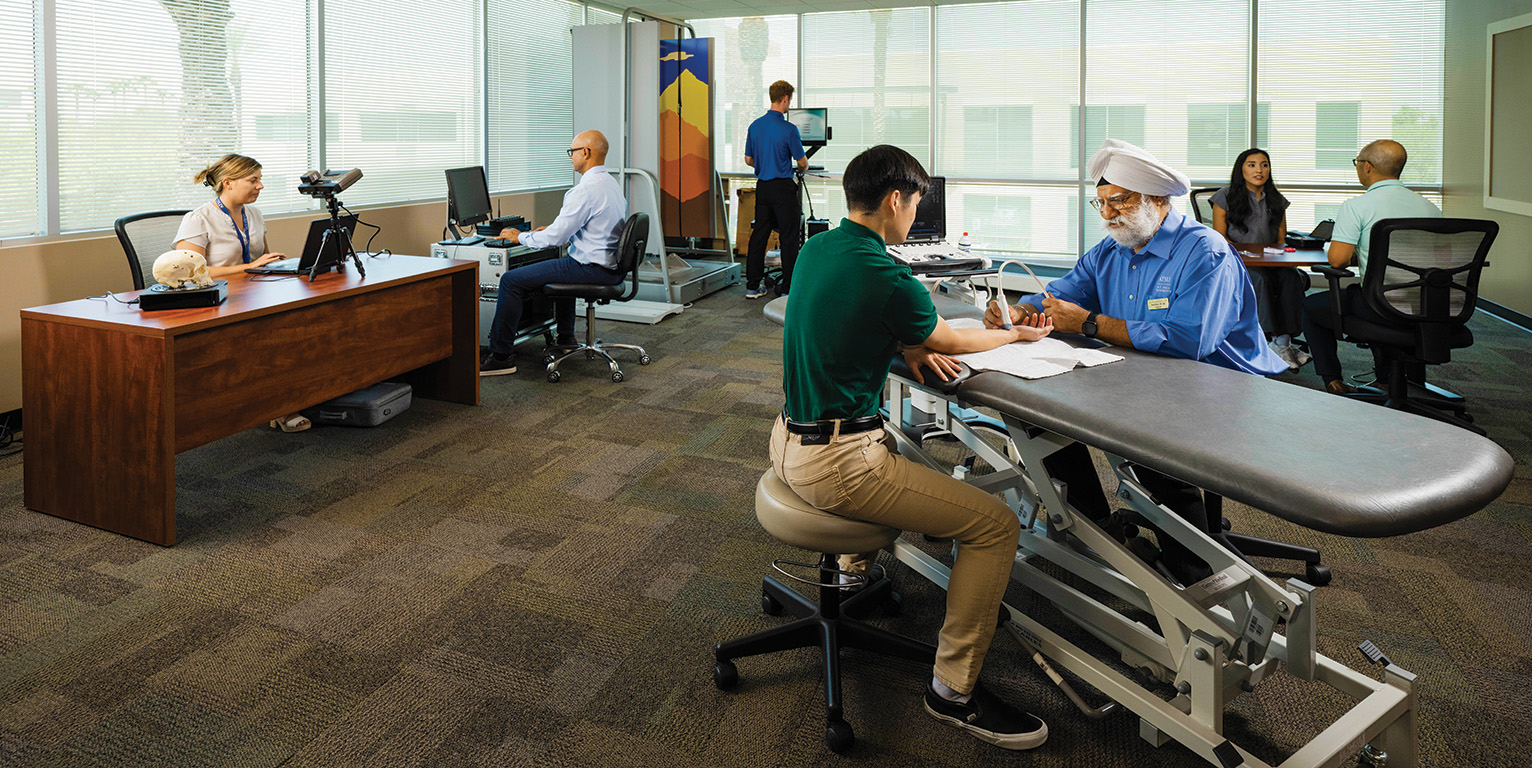
A shared research space brings faculty and students together to explore questions crossing disciplines and pushing healthcare research forward.
Established in 2004, the Interdisciplinary Research Laboratory (IRL) was relocated to the second floor of 5845 Building where it opened its renovated space in summer 2025.
The approximately 1,000-square-foot shared space is divided into six working zones, with dedicated areas for bioinstrumentation and biometric data collection and analysis.
The IRL brings together an array of technologies, including diagnostic ultrasound, muscle and nerve activity recording, gait and balance analysis, eye tracking, physiologic sensors, and 3D imaging.


The IRL is more than a collection of sophisticated equipment; it is a physical space where multiple disciplines, perspectives, and questions come together. The lab is a shared space, not restricted to a single department or research team. Students are able to join active projects as research assistants or complete mentored capstone and scholarship work with faculty, gaining experience in research extending beyond what they learn in a classroom.
“The support we’ve received from the University is what makes this lab possible – not just the space and the instruments, but the trust to build something shared,” says Kellie C. Huxel Bliven, PhD, ATC, FNAP, professor and chair of interdisciplinary health sciences at ATSU’s Arizona School of Health Sciences (ATSU-ASHS) and director of the IRL. “Each of us is advancing knowledge in our own discipline, and because we do it in the same room, we end up generating knowledge together that none of us would have reached on our own.”
One project brings together Dr. Bliven’s expertise in musculoskeletal imaging with the ultrasound and blood-flow expertise of Inder Raj S. Makin, MD, PhD, professor at ATSU’s School of Osteopathic Medicine in Arizona; the occupational therapy and hand therapy expertise of Tania Shearon, DHSc, CHT, C-IAYT, FNAP, associate professor, ATSU-ASHS; and four third-year dental students at ATSU’s Arizona School of Dentistry & Oral Health.
Together, the team is studying the median nerve in dental students and practicing dentists, looking for early signs of strain that could eventually affect hand function. In addition to helping design the study and conduct pilot testing, the students will play an integral role in data collection and analysis.
Another collaboration examines how patient positioning affects the muscles surrounding the shoulder blade. Four physical therapy students conducted the project under the guidance of Dr. Bliven and J.A. Graves, PT, DPT, assistant professor and co-director of clinical education, physical therapy, ATSU-ASHS, using diagnostic ultrasound to observe changes in muscle orientation and depth as a patient shifts position.
Additionally, the IRL demonstrates how interdisciplinary research extends beyond physical health. Quincy Conley, PhD, director of ATSU’s Teaching & Learning Center, led a team using eye tracking and other biometric tools to study how graduate health sciences students navigate different Canvas course layouts. The research helps faculty develop evidence-based course designs to make online learning easier to navigate and more effective.
For Dr. Bliven, the space’s value ultimately comes down to what happens when researchers with various expertise work alongside one another.
“It’s rare for a university to invest in a research space that doesn’t belong to any one of us, and ATSU did exactly that,” she says. “Each of us walks in with questions from our own discipline, and because we work side by side, we walk out with questions we never would have thought to ask alone.”