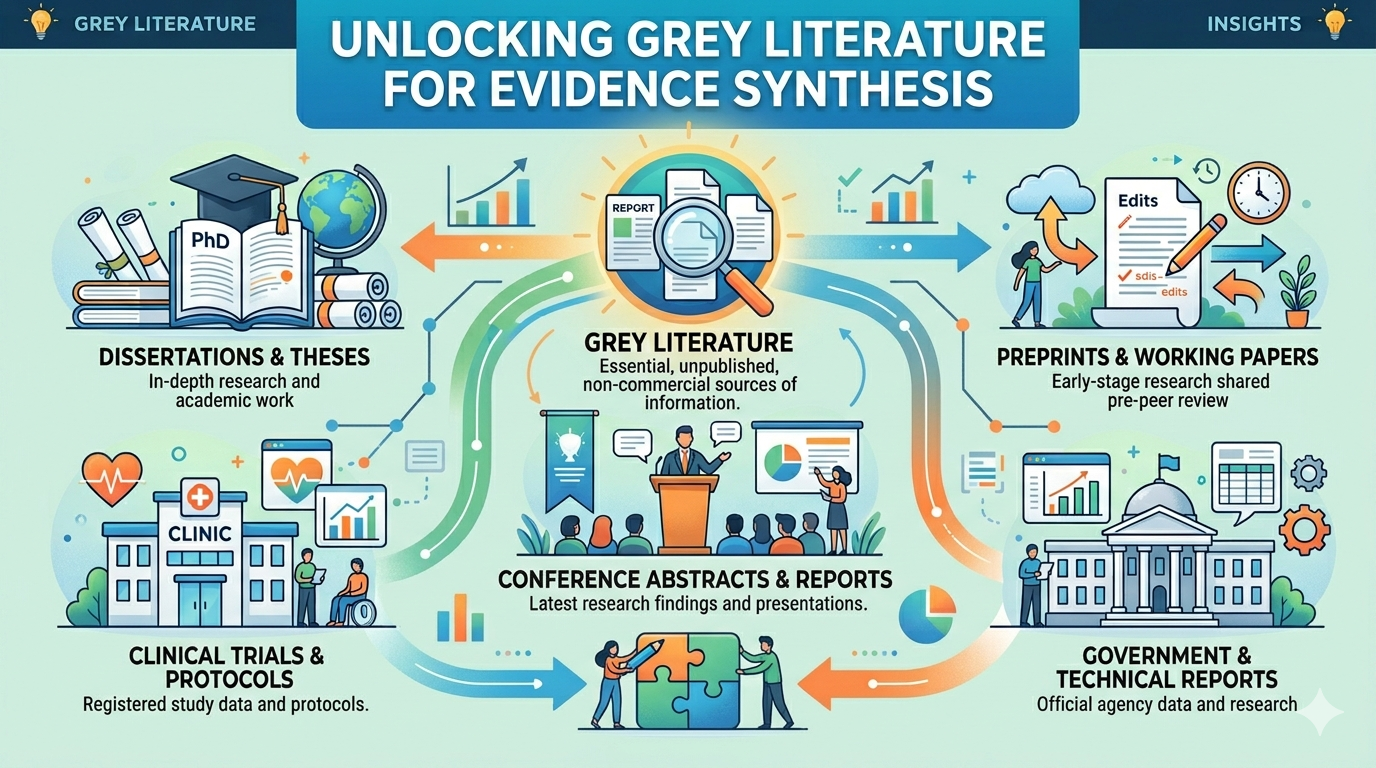

In the world of evidence synthesis (think scoping and systematic reviews), the most visible research is often just the tip of the iceberg. To conduct a truly comprehensive review, researchers must look beneath the surface at grey literature.
Grey literature is information produced by government agencies, academic institutions, businesses, and industries in formats not controlled by commercial publishing.
The goal of evidence synthesis is to capture all available evidence applicable to a research question. Relying solely on academic journals can lead to a skewed understanding due to:
These are the “go-to” sources for intervention-based clinical questions. They capture in-progress and completed trials that may not yet be reflected in published journals.
Government agencies produce high-quality statistical reports and white papers. If an agency works in your research area (e.g., CDC for public health or AHRQ for patient safety), search their site directly. Here are a few examples:
Preprints allow you to find completed research shared before it has been peer-reviewed, bypassing the traditional “publication time-lag.” Here are some common preprint servers:
Organizations often produce “invisible” literature—reports, white papers, and newsletters—that will not be found in databases. Unsure of where to find organizations in your field? Take a look at the resources below:
Dissertations and theses are normally not indexed in general bibliographic databases such as MEDLINE. There are exceptions though, and in CINAHL and PsycInfo you can search by “Source Type” and select Dissertations. See what this looks like below:

We have even more information on our Grey Literature LibGuide, including how to cite and appraise grey literature. Please check it out. And remember, if you have any questions, please contact your liaison librarian, we are here to help!