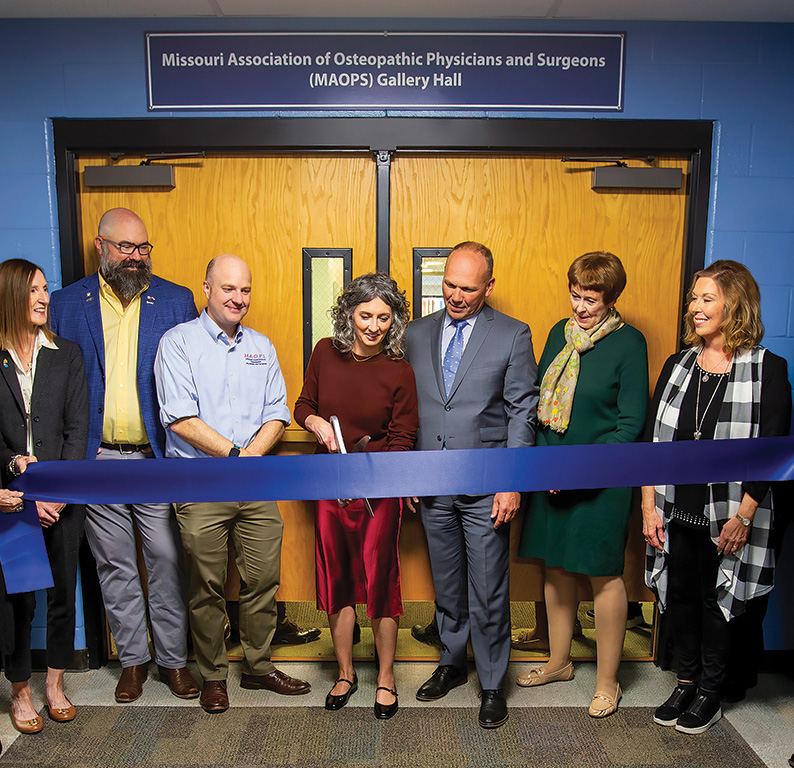
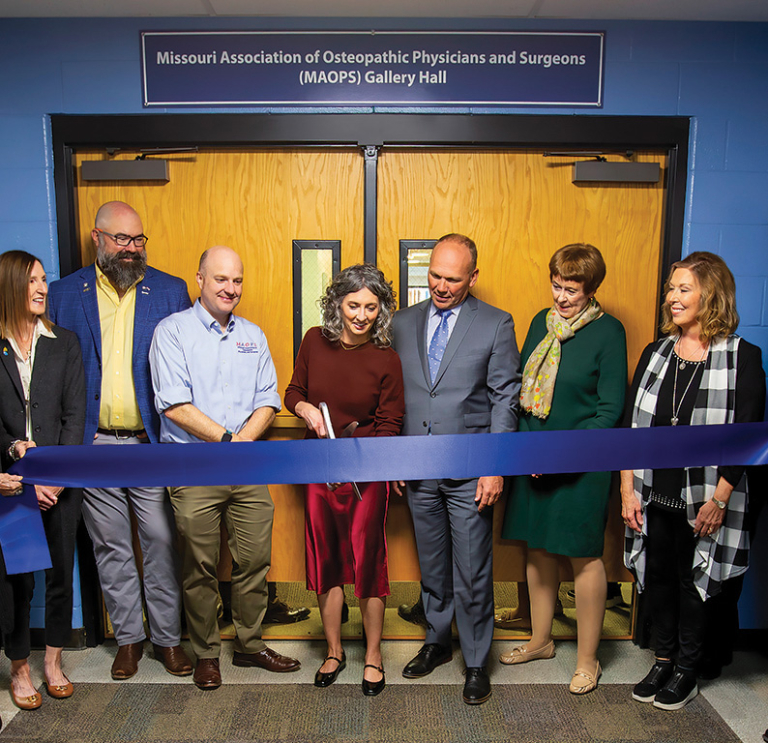
ATSU faculty and staff joined the Board of Trustees and University administration for a dedication of the Missouri Association of Osteopathic Physicians and Surgeons (MAOPS) Gallery Hall on Thursday, Oct. 27, 2025, during Founder’s Day activities. The dedication ceremony honored MAOPS’ significant contributions to the Museum of Osteopathic Medicine and its continual advocacy on behalf of the osteopathic profession.
ATSU Chief Advancement Officer Bob Behnen, MBA, kicked off the ceremony by welcoming guests and recognizing those in attendance. In his remarks, Behnen highlighted the centrality of charitable support to the continued operation of the museum and preservation of osteopathic history.
“Through their generosity, donors support exhibits that inspire, educational programs that enlighten, and the preservation of artifacts that tell the remarkable story of osteopathic medicine’s birth and evolution,” Behnen said. “Donor support not only sustains the museum’s daily work but expands its reach, inviting students, professionals, and the public to discover how osteopathy continues to shape healthcare today.”
ATSU Chancellor Craig M. Phelps, DO, ’84, described the growth and influence of osteopathic medicine. Its current scale dwarfs its humble origins. Today, at least one in four medical students are studying to become doctors of osteopathic medicine (DOs), a number which would be unthinkable during the early days of the profession given the persistent resistance with which it was met. This being the case, it is more important than ever to preserve its history and heritage. Dr. Phelps emphasized how the museum is key to this preservation because it houses unique artifacts relating to the origins of osteopathic medicine and philosophy of A.T. Still, DO. Founded in 1934, the museum’s collections include more than 100,000 objects, photographs, documents, and books. These items extend back to the early 1800s and offer a diverse outlook on the discipline from its inception to the present day.

Through a generous six-figure donation, MAOPS contributes actively to these preservation efforts and, in doing so, helps maintain the osteopathic profession’s integrity. However, this is not the only way MAOPS supports osteopathic medicine. In his speech, Dr. Phelps reminisced on the profound impact MAOPS had on him as a student and its continued outreach today.
“They’re the folks who are doing the work every single day so the physicians can do what they need to do and enjoy what they do,” Dr. Phelps said.
Since its inception in the late 19th century, osteopathic medicine has consistently been met with controversy. As Dr. Still began to develop his philosophy and sought to share his findings, those around him were quick to denounce the tenets of whole person healthcare he presented. One church went so far as to deem osteopathy as sacrilege, and universities forbid Dr. Still from sharing his ideas on their campuses. After struggling for some time to find a community where he would be accepted, Dr. Still eventually landed in Kirksville, Missouri, where he would establish his practice and, in 1892, the American School of Osteopathy, known today as ATSU’s Kirksville College of Osteopathic Medicine (ATSU-KCOM).

Founded a few years later in 1897, MAOPS works tirelessly to ensure DOs share the same rights as doctors of medicine (MDs). MAOPS provides DOs with an invaluable net of support and resources, enabling them to focus on their work, rather than the bureaucratic framework surrounding it. As an organization, MAOPS recognizes the importance of the University as common ground for DOs around the world. Katie Davenport-Kabonic, DO, ’12, president of MAOPS’ Board of Trustees and alumna of ATSU-KCOM, expressed appreciation for the association’s recognition and reiterated the importance of advocacy.
“MAOPS is an organization of osteopathic physician members from all stages of training and from all specialties,” Dr. Davenport-Kabonic said. “We are made of many members who have walked through this very hall and many members who originated from other colleges and states, with their own halls of osteopathic knowledge having found their pathway to Missouri to serve our communities. We are fortunate to be a family of so many backgrounds, so many pasts, and futures. Whether or not we study or practice osteopathic medicine on these very grounds, we all share our common roots here in Kirksville.”
Following Dr. Davenport-Kabonic’s remarks, Dr. Phelps unveiled a plaque symbolizing the University’s gratitude for MAOPS’ unwavering support and generosity, with a ribbon-cutting held at the hall’s entryway to Heritage Hall. The MAOPS Gallery Hall now serves as a testament to the power of advocacy and unity, and honors the commitment of an extraordinary group of individuals whose efforts will echo across the osteopathic profession for years to come.