General Goal: To know the major cause of this disease, how it is transmitted, and the major manifestations of the disease.
Specific Educational Objectives: The student should be able to:
1. recite the most common cause of tularemia (shape and gram stain?).
2. describe the common means of transmission.
3. describe the major manifestations of this infection.
4. describe how you diagnose, treat and prevent this infection.
Reading: MEDICAL MICROBIOLOGY by P.R. Murray, K.S. Rosenthal, and M.A. Pfaller, 6th Edition. pp. 357-361.
Tularemia is a general term for several forms of disease caused by Francisella tularensis. The most common form of the disease is an indolent, febrile condition manifested by a skin ulcer and enlarged, tender regional lymph nodes. F tularensis is a hardy non–spore-forming organism that is capable of surviving for weeks at low temperatures in water, moist soil, hay, straw, or decaying animal carcasses. It is on the United States Centers for Disease Control’s list of category A biological weapons.
All forms of tularemia are caused by F tularensis, a gram-negative coccobacillus.
F tularensis can cause several different forms of disease, depending on how the organism is acquired; these diseases include ulceroglandular, oculoglandular, pneumonia, typhoidal, and oropharyngeal. Each type of disease and its manifestations will be discussed below.
Ulceroglandular tularemia is the most common form of the disease and has an incubation period following inoculation in the skin of about 48 hours. Initially, a papule (erythematous, pruritic bump) forms at the inoculation site. The overlying skin becomes taut, thin, and shiny, but not fluctuant (movable and compressible). About 96 hours later, the enlarging papule ulcerates leaving an ulcer in the skin. Many patients will also have a fever with abrupt onset that can last up to 1 month in the absence of treatment. The patient may have a headache and occasionally photophobia. Patients may also develop a regional lymphadenopathy in the area that drains the wound site.
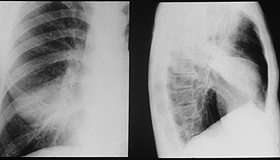
Pneumonic tularemia is the most serious form of tularemia and is often a complication of the typhoidal and ulceroglandular forms of tularemia. Signs and symptoms include a nonproductive cough, substernal burning, and rhonchi. Nausea, vomiting, diarrhea, and abdominal pain are common in pneumonic tularemia and in pneumonia due to Legionella pneumophila (Legionnaire’s disease) but are rare in the more common bacterial causes of pneumonia (e.g., Streptococcus pneumoniae). Chest radiographs may be normal or may show peribronchial patchy infiltrates, effusions, and hilar adenopathy. Apprehension and toxicity are marked and shock is common.
Typhoidal tularemia can result in an endotoxemia produced by the bacilli lysing in the blood. Symptoms include a continuous fever (without chills or sweats), myalgia, severe headache, and hepatosplenomegaly.
Oropharyngeal tularemia is an acute exudative or membranous pharyngotonsillitis with cervical lymphadenopathy.
Oculoglandular tularemia is the rarest form of tularemia. Symptoms include pain, photophobia, intense ocular congestion, itching, lacrimation, edema of the ocular conjunctiva, and mucopurulent discharge.
F tularensis is able to enter through unbroken skin and has an incubation period of infection of 1–21 days. If the organism enters the skin, a papule forms at the site of entry, which develops into an ulcer and is accompanied by fever and lymphadenopathy. If organisms enter the bloodstream, they are entrapped in the reticuloendothelial organs, where they proliferate and induce abscesses and granulomata. Bacilli survive inside monocytes, which contributes to relapses.
If the organisms are inhaled, multiple necrotizing granulomata form and destroy alveolar septa, resulting in bronchopneumonia, bronchitis, or tracheitis. Bacteremia can occur when alveolar macrophages containing F tularensis enter the hilar lymphatics.
About 1 million bacilli are required to cause disease following ingestion. Patients usually develop pharyngitis and cervical lymphadenopathy. Wiping the eye with contaminated hands can result in infection of the conjunctival sac and nearby lymphatic glands (oculoglandular tularemia).
Tularemia is an acute febrile illness that rarely produces a leukocytosis. The erythrocyte sedimentation rate and the C-reactive protein are elevated. Contact with rabbits, ticks, or deer flies are informative, but not required. Smears of aspirates from enlarged lymph nodes usually contain the organisms. Patients who present with skin ulcers and enlarged regional lymph nodes accompanied by fever must be diagnosed as having tularemia until proven otherwise. F tularensismay be identified through direct examination of lymph node aspirates using Gram stain, direct fluorescent antibody, or immunohistochemical stains.
The severe forms of tularemia (pneumonic and typhoidal) are more difficult to diagnose. Gram stain of the sputum is usually not helpful in visualizing F tularensis. An immunofluorescent reagent is available for use directly on smears of sputum.
Culture of F tularensis from sputum, bronchial or gastric washings, or blood is possible in guinea pigs or on glucose-cystine-blood agar containing cycloheximide and penicillin G to suppress normal flora. If a sample is sent to the lab they should be alerted to use special diagnostic and safety procedures because of the highly contagious nature of F tularensis that has resulted in several documented laboratory infections while handling patient samples. Some labs will not process samples from patients suspected of having tularemia.
F tularensis may be identified through direct examination of secretions, exudates, or biopsy specimens using Gram stain, direct fluorescent antibody, or immunohistochemical stains. Microscopic demonstration ofF. tularensisusing fluorescent-labeled antibodies is a rapid diagnostic procedure performed in designated reference laboratories in the National Public Health Laboratory Network; test results can be available within several hours of receiving the specimens, if the laboratory is alerted and prepared. Unfortunately, rapid diagnostic testing for tularemia is not widely available. PCR can also be used to identify F tularensis infections.
The drug of choice for treatment of tularemia is streptomycin; however, gentamicin is also effective. Without therapy, fatality rates range from 5% (ulceroglandular) to 30% (pneumonic). Infection provides lifelong partial immunity. An attenuated strain of F tularensis is available as a vaccine for persons at risk of acquiring tularemia (e.g., veterinarians, hunters). Gloves should be worn when dressing rabbits. Insect repellents should be applied to prevent tick and deer fly bites. Ticks should be removed promptly.
Send comments and email to Dr. Neal R. Chamberlain, nchamberlain@atsu.edu
Revised 11/20/14
©2014 Neal R. Chamberlain, Ph.D., All rights reserved.