Doctor of Health Sciences degree online

A.T. Still University’s (ATSU) Doctor of Health Sciences (DHSc) online program is designed for students looking for professional advancement, evidence-based knowledge, and practical research experience. Consisting of 70 credit hours of study, the DHSc curriculum is flexible, as well as rigorous, preparing students to critically analyze ongoing national and global challenges relating to healthcare access, cost, education, and quality. The coursework builds competencies required to skillfully evaluate, plan, and implement solutions to pressing healthcare concerns and culminates with an Applied Research Project designed to enhance the health of society.
For students looking to earn a terminal degree without a dissertation, the Doctor of Health Sciences online degree offers a comprehensive and supportive program led by diverse and experienced full-time and adjunct ATSU faculty. DHSc degree alumni agree that the program and its stellar faculty prepared them for leadership roles in healthcare and academia.
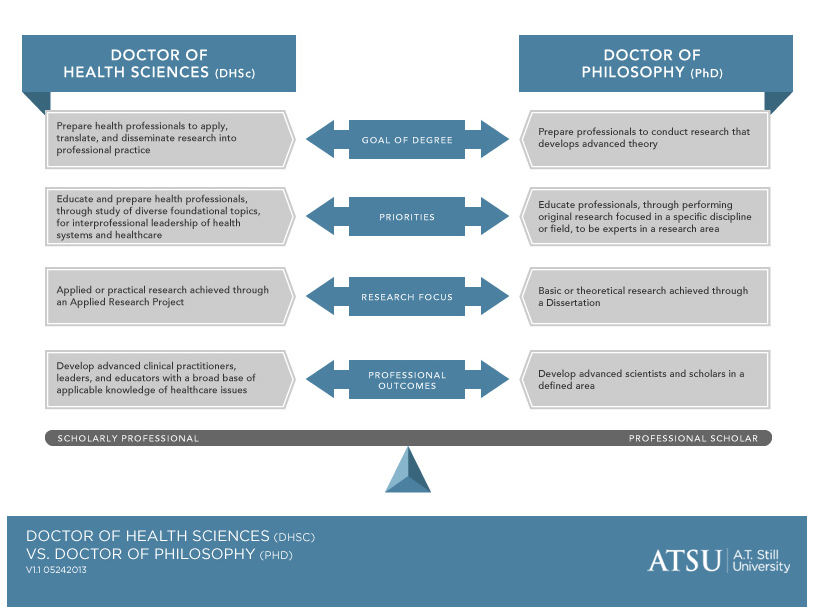
Compared to a traditional PhD, the Doctor of Health Sciences online degree provides graduates with the skills needed to directly apply, translate, and disseminate research into their clinical practice.
Certificates in Health Sciences
The specialty tracks available for Doctor of Health Science students are also offered as independent graduate certificates which can demonstrate expertise in a particular concentration in just four courses. Certificate holders can then transfer in nine credits toward completion of the DHSc program.
Fundamentals of Education prepares clinical practitioners to transition into roles in academia or healthcare education through studying the components of designing, developing, and managing courses informed by the most up-to-date educational theories and techniques.
Global Health provides future leaders with the tools and knowledge needed to formulate innovative solutions meant to address the quality of healthcare for underserved populations. International health issues are explored in this coursework as well as their impact on policy development, population health, and application of ethical principles.
Leadership and Organizational Behavior provides specialized knowledge and advances critical thinking and theory application in healthcare administration. Develop specialized leadership skills that will help understand the intricacies of human behavior in the workplace.

online flexibility

customizable:
4 concentrations

GRADUATE IN
3-4 years

develop applied
research project

no dissertation
required

4 START DATES
PER YEAR
Doctor of Health Sciences (DHSc) vs. Doctor of Philosophy (PhD)
The Doctor of Health Sciences degree is a unique approach to doctorate level health education. The ATSU Doctor of Health Sciences degree provides interdisciplinary scholarship and added value to health professionals in comparison to the traditional PhD.
Certificates in Health Sciences
The Health Sciences programs also offer our specialty concentrations as independent certificates in health sciences for those who wish to gain the knowledge and expertise of one or more of these concentrations. Each certificate contains four courses (12 credits) and can be completed 100 percent online. Those who go on to complete the full DHSc or MHSc may transfer in 9 credits from the completed certificate. Find more information about the specialty certificates here.
Program essentials
Doctor of Health Sciences Curriculum Overview
The Doctor of Health Sciences (DHSc) online program consists of 70 credit-hours of study. The DHSc degree curriculum aims to develop and enhance the professional skills needed to provide competent leadership in today’s challenging healthcare systems.
All core courses in the Doctor of Health Sciences program are Quality Matters certified..

Requirements
- Application:
- Completed and signed admissions application along with a nonrefundable application fee.
-
Academic:
- An accredited masters degree or higher from a university recognized by the Council for Higher Education Accreditation. Applicants who received their qualifying degree from a university outside the United States will have to provide a degree equivalency evaluation.*
- Official transcript from the qualifying degree-granting institution. For students using VA benefits transcripts for all institutions attended are required.
- Minimum Cumulative Grade Point Average (CGPA) of 2.5 (on a 4.0 scale) at the qualifying degree institution.
- Proof as a licensed or credentialed healthcare professional and/or have two years recent experience as a practitioner, administrator, educator, clinician or researcher in healthcare.
-
Elements of Success:
- A current resume
- Completion of an essay
- English Proficiency **
- Meet technology requirements***
*Applicants who have graduated from a foreign college or university should submit acceptable evidence of U.S. degree/course equivalency. All course work taken at the foreign institution must be evaluated for American institution equivalence by one of the following services:
- World Education Services P.O. Box 5087 Bowling Green Station New York, NY 10274-5087 p: (212) 966-6311 f: (212) 739-6139 info@wes.org
- Educational Credential Evaluators, Inc. P.O. Box 514070 Milwaukee, WI 53203-3470 (414) 289-3400
- American Assn. of Collegiate Registrars & Admissions Officers One Dupont Circle, NW, Suite 520 Washington, DC 20036-1135 (202) 293-9161
- Josef Silny & Associates, Inc. International Education Consultants 7101 SW 102 Avenue Miami FL 33173 p: (305) 273 -1616 f: (305) 273 -1338 info@jsilny.com
- Intl. Education Research Foundation, Inc. PO Box 3665 Culver City, CA 90231-3665 (310) 258-9451
**Applicants are required to demonstrate proficiency in English when applying to A.T. Still University’s College of Graduate Studies. Written and spoken proficiency in the English language may be demonstrated by one of the following options:
- Option 1 - English is your first language.
- Option 2 - Graduated from a regionally accredited four year college/university in the United States with a BA/BS or graduate degree.
- Option 3 - You are demonstrating your English proficiency by submitting acceptable scores on the Test of English as a Foreign Language (TOEFL).
Accepted test types for CGHS are:
The Computer Based Test (CBT), Internet Based Test (iBT), or the Paper Based Test (PBT) are accepted. The following are the minimum required score based on test type:
- CBT - minimum total score of 213
- iBT - minimum total score of 80
- PBT - minimum total score of 550
The TOEFL is administered by TOEFL/TSE Services, P.O. Box 6151, Princeton, NJ, 08541-6151, USA 609. 771.7100. A.T. Still University’s institutional code is 0339. Please be sure to include this information when you submit your application packet. TOEFL Educational Testing Services P.O. Box 6151 Princeton, NJ 08541-6151, 609.771.7100
***ATSU technology requirements
Career advancement
According to the Bureau of Labor statistics, the healthcare field is predicted to grow by 2.4 million jobs by 2029; that is more than any other industry.
- Healthcare delivery systems
- Research practice
- Clinical trials
- Health policy
- Clinical practice
- Healthcare education
- Health administration
- Healthcare informatics
Year 1
Year 2
Year 3
Fundamentals of Education Concentration
-
Educational Program Evaluation+
-
Students will be introduced to educational program assessment and evaluation. Topics include meeting health programmatic accreditation requirements, creating academic institutional effectiveness plans, program creation and revision, curricular evaluation, and strategic program assessment at the college and university level. Other topics discussed include evaluating certification and licensure pass rates, retention and attrition statistics, and integrating advisory board guidance into educational programs.
-
-
Contemporary Teaching and Learning Concepts+
-
This course is an overview of some of the current models and theories that are becoming popular in higher education. Much research has focused on academia over the past few years to determine how best to educate students in a cost effective, productive manner. Some of the more prominent theories include: learner-centered teaching, student-centered learning, inter-professional learning, and distance education. The purpose of this course is to explore the research and practical application of contemporary models of education. Students will examine various models and philosophies of delivering and managing course content, promoting knowledge transfer, and determining best practices for effective teaching.
-
-
Curriculum and Course Design+
-
The purpose of this course is to expand knowledge and understanding of curriculum and course development. The course is designed to engage students in developing course syllabus, assignments and grading rubrics, lesson plans, and a course outline. Students will explore strategies that promote student learning based on best teaching practices.
-
Global Health Concentration
-
Global Health Issues+
-
This course provides an introduction to important global health issues, including determinants of health, key areas of disease burden, and the role that new health technologies can play in solving these problems. The goal of the course is to expand students’ understanding of the impact of infectious and chronic diseases on the world’s population with particular attention paid to the health status of women, children, and the poor. Students will examine case studies of successful global health interventions to understand features of successful programs.
-
-
Globalization and World Politics+
-
This course introduces the theoretical and practical issues associated with the radical global processes that are now affecting human life locally and globally. The course emphasizes the political-economic, cultural, institutional, technological, and ecological implications of globalization and allows students to evaluate whether these processes pose opportunities or challenges to individuals, societies, and the global community.
-
-
Public Health Emergency Preparedness and Disaster response+
-
For years public health has played a critical role in responding to emergencies and disasters of all kinds. This course examines the roles and responsibilities of public health during a disaster and emergency. You will examine the various types of disasters and emergencies, including bioterrorism, infectious disease outbreaks, and natural disasters, and learn how a response is planned, initiated and coordinated. This course will also introduce you to emergency preparedness planning and common concepts, principles, terminology, and organizational processes used including the National Response Framework (NRF), Incident Command System (ICS) and the National Incident Management System (NIMS).
-
Leadership and Organizational Behavior Concentration
-
Organizational Behavior+
-
This course examines how the personal characteristics of organizational members influence the effectiveness and productivity of organizations and the job satisfaction of its members. It is believed that organizations are comprised of three levels: the individual, the group or department, and the organization itself. This course will focus on the problems and challenges leaders face in dealing with the individual and the small groups in the organization. Special attention will be given to the role of teams in organizations, the stages of team development, and actions that can support the development of effective teams. The realities of interpersonal processes are considered through examination of the roles of power, politics, and conflict in organizations. The human side of organizational change is then explored with a focus on understanding how and why people react to organizational change and identifying opportunities for enhancing the effective implementation of change.
-
-
Healthcare Economics and Financial Management+
-
Students will use key financial and economic principles to examine executive level decisions relative to capitalization, credit ratings, debt capacity, alternate funding sources, business plan development, and overall organizational finance strategy. The concepts will be considered from both non-profit and for-profit healthcare organizational perspectives.
-
-
Strategic Change Management for Healthcare Organizations+
-
In this executive course, students will investigate and integrate change management practices to strategically position the healthcare organization for the future. Students will assess their organization’s current strategic position and apply relevant theoretical models and the necessary change management practices resulting in organizational adaptability.
-
Generalist
Pick any 3 courses from the three program concentrations to complete the generalist concentration.
Tuition
Review tuition and fees for Doctor of Health Sciences program. Please note tuition and fees are subject to change.
Financial Aid
Federal financial assistance is available for qualifying students. For information about financial aid, visit ATSU’s Enrollment Services online or contact them at 660.626.2019 or by email at enrollmentservices@atsu.edu.

Associate Professor

Dr. Alexander completed his doctor of philosophy degree at Arizona State University (2003) in curriculum and instruction with an emphasis in exercise and wellness. He earned his Master of Science in exercise physiology from Brigham Young University and his bachelor’s degree in health promotion.
In addition to his academic preparation, Dr. Alexander holds numerous health and fitness professional certifications; namely, Clinical Exercise Specialist® from the American College of Sports Medicine (ACSM) and Certified Personal Trainer and Corrective Exercise Specialist from the National Academy of Sports Medicine (NASM). Consequently, Dr. Alexander has served as a personal and group fitness trainer primarily working closely with the older adult population.

Associate Professor and Chair
Kathleen DiCaprio, PhD, has been named chair for the Doctor of Health Sciences (DHSc) program in the ATSU College of Graduate Health Studies. She previously served as an assistant professor of microbiology and immunology at Touro College of Osteopathic Medicine in New York, as well as the director of content development and education at Oceania University of Medicine. In addition, she served as an instructor and curriculum consultant for Kaplan Medical.
Dr. DiCaprio has a history of teaching undergraduate, graduate, and medical courses in areas related to infectious diseases and infection control, immunology, public health, and emergency preparedness. She comes to ATSU with an impressive history as a faculty member and administrator in higher education of the medicine and the health sciences.
Dr. DiCaprio earned her BS in biochemistry from The College of Saint Rose and her PhD in pathology from Uniformed Services University of the Health Sciences. Her prior research focused on studying pathogenesis of maximum containment (Biosafety-level 4) viruses such as Ebola and Marburg in non-human primate models. Her research efforts contributed to the development of potential vaccines and therapeutics against these deadly viruses, and her work has been profiled in numerous publications and press releases.

Associate Professor
Dr. Mathieson completed her PhD in sociology at Arizona State University, with a focus in the areas of statistics and sociology of health. Before coming to ATSU, she spent five years as a research analyst and biostatistician at Maricopa Medical Center, a 449-bed teaching hospital in Phoenix.
While at Maricopa Medical Center, Dr. Mathieson taught research and statistics courses to medical residents in various specialties, and co-authored research articles with faculty and residents in areas such as obstetrics and gynecology, emergency medicine, pediatrics, family practice, and public health. Since coming to ATSU, Dr. Mathieson has collaborated on both quantitative and qualitative research projects in various programs, and has begun her own research in the area of teaching and learning. She is also interested in research ethics and is the vice-chair of the ATSU-Arizona Institutional Review Board. Dr. Mathieson enjoys working with students, particularly in the process of mentoring them through research projects.

Professor
Dr. Matthews completed his PhD in education at Southern Illinois University with an emphasis in adult and vocational/technical education (workforce education and development). He also holds graduate degrees in education (administration and supervision) and museum studies. His professional medical preparation is in the field of diagnostic imaging. Dr. Matthews is certified in diagnostic radiography, cardiovascular-interventional technology, and magnetic resonance imaging by the American Registry of Radiologic Technologists. Prior to coming to ATSU, he was the program director of the radiography program at Southern Illinois University.
Dr. Matthews has taught numerous courses on medical and educational history, his primary research interest. He enjoys qualitative-historical research and has served as a subject matter expert for several state and national organizations and museums on the topic of 19th century American medicine.

Assistant Professor
Dr. Weemer completed her Doctorate of Health Sciences degree at Indiana State University, with focus in the areas of health promotion, physical activity and wellness. She earned a Master of Science in physical education from Eastern Illinois University and also a Master of Science in Teaching health education from Northern Illinois University. She earned her undergraduate degree in dietetics.
In addition to her academic preparation, Dr. Weemer is a Master Certified Health Education Specialist (MCHES). She has an extensive history of teaching undergraduate and graduate health science courses in various modalities, along with experience revising courses and curriculums. Dr. Weemer’s research interests focus on the scholarship of teaching and learning, along with examining risk and protective factors surrounding adolescent and college student health.

Dean
Marisa Hastie, EdD, MS, ACSM-EP, PN-1, FACSM is the Dean of the College of Graduate Health Studies at AT Still University. Dr. Hastie received her doctor of education from George Fox University (2013), her master of science in exercise and sport science with an emphasis in biomechanics from the University of Oregon (2003), and her bachelor of science in exercise science from Gonzaga University (2001). She is a fellow of the American College of Sports Medicine (ACSM) and is a certified Exercise Physiologist.
Prior to joining ATSU, she was a Professor of Exercise Science and Program Chair for the Exercise Science Program at Lasell University (Newton, MA). Dr. Hastie also served as the Faculty Fellow for the Fuss Center for Research on Intergenerational Education and Aging and received the deWitt Excellence in Educational Leadership Award from Lasell University. Dr. Hastie served as Faculty Chair of the University’s governance system.
Dr. Hastie has served in several leadership roles at the regional and national level of the ACSM, which include her current roles on the Professional Education Committee at the national level and as the President-Elect for the New England chapter. Her research interests have included exploring the connection between lifelong physical activity and long-term health outcomes, the relationship between exercise training and cognition, and the effects of discrimination experiences on health-related coping behaviors.
Dr. Hastie has extensive experience in online program development, teaching, and assessment. She developed an online Master of Science in Nutrition for Human Performance program and has 18 years of experience in both synchronous and asynchronous teaching formats. She became an educator because she strongly believes in the development of the whole student as a crucial responsibility of higher education institutions.
Chair and Associate Professor
Kathleen DiCaprio, PhD, has been named chair for the Doctor of Health Sciences (DHSc) program in the ATSU College of Graduate Health Studies. She previously served as an assistant professor of microbiology and immunology at Touro College of Osteopathic Medicine in New York, as well as the director of content development and education at Oceania University of Medicine. In addition, she served as an instructor and curriculum consultant for Kaplan Medical.
Dr. DiCaprio has a history of teaching undergraduate, graduate, and medical courses in areas related to infectious diseases and infection control, immunology, public health, and emergency preparedness. She comes to ATSU with an impressive history as a faculty member and administrator in higher education of the medicine and the health sciences.
Dr. DiCaprio earned her BS in biochemistry from The College of Saint Rose and her PhD in pathology from Uniformed Services University of the Health Sciences. Her prior research focused on studying pathogenesis of maximum containment (Biosafety-level 4) viruses such as Ebola and Marburg in non-human primate models. Her research efforts contributed to the development of potential vaccines and therapeutics against these deadly viruses, and her work has been profiled in numerous publications and press releases.
University Catalog
The ATSU Doctor of Health Sciences degree post-professional program offers focused, interprofessional learning in a flexible, online environment tailored for busy healthcare professionals. The online health science degree is achievable in three years, has various areas to concentrate learning, and 100 percent of study can be completed online.
Read the University Catalog to learn more about the Doctor of Health Sciences online program and university.
A.T. Still University is accredited by the Higher Learning Commission
230 S. LaSalle Street, Suite 7-500,
Chicago, IL 60604
Phone: 800.621.7440 | Fax: 312.263.7462
Email: info@hlcommission.org
Doctor of Health Sciences Degree Faculty
Faculty Forums
Student Insights
I think what best summarizes my choice of the DHSc was its direct relation to health sciences as opposed to some of the more arcane disciplines inherent in many PhD programs. This is not an exercise in merely obtaining a doctorate degree but in obtaining a degree which can actually further my educational and professional goals.
—Mark, ATSU DHSc student
The DHSc is the best of both worlds. It is the integration of both research and practice. It is the focus on applied research with the end goal to affect the delivery of healthcare.
—Melanie, ATSU DHSc student
I wanted more of a liberal and critical preparation approach to academics. The DHSc fits the need. It prepares us for clinical continuation, but has the applied portions of thinking infused with research.
—Debbie, ATSU DHSc student
Health Sciences Purpose/Mission/Values
DHSc Program Purpose Statement
The Doctor of Health Sciences (DHSc) program provides a rigorous interdisciplinary education for healthcare professionals, preparing students to be effective leaders and change agents in a variety of health settings. The program offers innovative curriculum in a flexible, asynchronous format to best meet student needs. Courses are facilitated by experienced faculty through an interdisciplinary and interprofessional approach. Coursework prepares students to critically analyze ongoing domestic and global challenges of access, cost, education and quality in healthcare, and builds competencies to skillfully evaluate, plan and implement solutions to these challenges.
DHSc Vision
The DHSc program has adopted the vision statement of the College of Graduate Heath Studies, adapting it to the program:
The DHSc program will be the preeminent online program for leaders in the health professions. We will provide a contemporary and flexible curriculum that empowers our students to translate knowledge to meet the growing needs of domestic and global health and wellness.
DHSc Values
The DHSc program has adopted the values of the College of Graduate Health Studies:
- Leadership: We value leadership development for our students, faculty, and staff and encourage participation in community and professional service.
- Integrity: We value the highest ethical principles of fairness and honesty in all of our interactions.
- Scholarship: We value critical thinking and the generation of ideas through innovation and analysis.
- Diversity: We value differences among people and their personal and professional perspectives.
- Interprofessional education: We value the combined contributions of our educational community and work to achieve an environment of teamwork and collaboration.
- Innovation: We value a continual and aggressive push to develop new and efficient mechanisms for learning, teaching, and technological delivery.
DHSc Goals
Goals of the DHSc program are to provide an online environment that:
- Promotes diversity of student experiences
- Fosters student success
- Honors professionalism and ethical practice
- Supports a curriculum that develops critical and analytical thinking skills through an integrative approach of instruction, research, and evidence-based resources
- Promotes and supports excellence in faculty performance in teaching, scholarship, and service
DHSc Outcomes
- Demonstrate advanced knowledge in health sciences fields, scholarship, and evidence-based practice.
- Demonstrate knowledge and skills for designing, conducting, analyzing and disseminating health sciences research.
- Demonstrate knowledge in critical analytical thinking skills in foundational areas of health sciences.
- Demonstrate advanced and effective skills in communication, professionalism, ethical practice, systematic thought, and writing.
Application
Review application deadline dates
For additional information contact an Enrollment Counselor:
877.626.5577 or cghsonlineadmissions@atsu.edu
Request Information
Have a question for ATSU?
Submit an inquiry for more information on your program of interest.
Missouri Campus
800 W. Jefferson Street Kirksville, MO 63501
877.626.5577
cghsonlineadmissions@atsu.edu

Not sure if the DHSc is right for you?
ATSU-CGHS offers a variety of doctoral programs that meet your professionals needs and career goals.